Wood, Eric & Geddis, Arthur.N. 1998. Self-conscious narrative and teacher education: representing practice in professional course work. Published in Teaching and Teacher Education 15 (1999) p107-119.
What the literature said in 1997 about teacher education.
This article was written in 1998 (around the time that I undertook teacher training). I think that it’s a forerunner for ‘congruent teaching’ called in this paper ‘self-conscious narrative’. ‘Self-conscious narrative’ supports trainee teachers with their developing pedagogical thinking.
The paper refers to teacher education research conducted by Houston, Bennett & Carre and Sikula. Schon is also referenced on ‘technical rationality’.
Schon’s writing argues that quantitive (scientific) research isn’t always suitable for teacher education as the research base tends to be studying the “expertise displayed by competent professionals” (p108). Qualitative research being the preferred type of research for teacher educators (which does necessarily fit in with the research profile of the university and the REF).
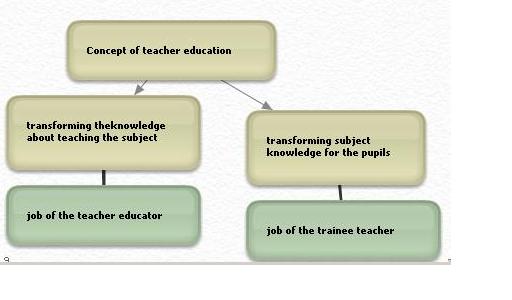
Wood and Geddis use the paper to investigate how teacher educators in university prepare trainee teachers for life in the profession. Which they see as “a complex, content specific enterprise inadequately explained by applied science conceptions of practice”. Teacher educators need to make explicit the implicit (p108) messages imbedded in the teacher educator’s practice – so explaining the form of the content?
explicating – to make clear the meaning of
teacher educators are different to the other academics within a university as their pedagogical practice is intertwined with their professional practise – as they teach about teaching (different to the business lecturer who teaches about business). A boring, dull physics lecturer is not modelling the content – however a boring, dull education lecturer will have an implicit impact on his/her students if the content is about education. How can you teach about active learning techniques in an hour lecture to 200 students, without sending out a mixed message about the content?

http://www.independent.co.uk/news/education/higher/another-boring-lecture-544213.html
There needs to be “coherence between the explicit and implicit messages of its instruction” (108). Do we need to talk to the trainee teachers about the dangers of this at the start of the academic year? have things moved on from 1998? are we in fear of them moving backwards as the university goes for cost cutting measures that will pull up the class size? will schools be able to develop pedagogical thinking if a trainee teacher only learns by doing the job and never has time to question the explicit and implicit philosophy of the purpose of education?
What’s teacher education all about?


 sdsdavies's blog